
Cost Breakdown: Commissioning a Hand-Knotted Silk Rug Price Guide in Delhi
Hand-knotted silk rug price is the first question buyers ask when they plan a custom carpet in Delhi. While every piece is unique, the final figure always comes from the same set of charges. CarpetsAndRug.com pulls back the curtain on each rupee so you can budget with confidence and avoid costly surprises.
Table of Contents
What Drives the Hand-Knotted Silk Rug Price?
Before listing numbers, know the seven forces that shape cost:
- Silk grade and weight
- Knot density (knots per square inch)
- Complexity of the design chart
- Weaver skill and daily wage
- Size of the loom and production time
- Finishing steps—washing, shearing, stretching
- Taxes, duties, and retail margin
Each part adds value, and together they form the final hand-knotted silk rug price you see on an invoice.
Silk Yarn: The Most Visible Cost
Raw Material Charges
High-quality mulberry silk is spun in Ramanagara and reeled into 20–22 denier threads. In May 2025 the average landed price in Delhi sits near ₹6,200 per kilogram. A 6 × 9 ft (1.83 × 2.74 m) carpet at 400 KPSI needs roughly 4.3 kg of yarn, so the starting bill for silk alone is ₹26,600.
Dyeing Fees
Natural and chrome dyes add another ₹600 per kg, covering colour lab, dye master fee, and water treatment. For the same rug, that is ₹2,580.
Running total so far: ₹29,180 for material and colour.
Design and Graph Charges
Even if you bring your own sketch, a weaving graph must be plotted on millimetre paper or digital CAD. Delhi designers charge ₹50–₹70 per square foot for standard geometrics and up to ₹120 for shaded pictorials. Our sample 54 sq ft rug at a mid-level pattern uses ₹3,780 in design labour.
Loom Setup and Knotting Labour
Daily Weaver Wage
Master knotters in the NCR region earn ₹600–₹750 per eight-hour day. At 400 KPSI a skilled pair ties about 2 in² daily. The 6 × 9 ft rug has 7,776 in², so man-days equal roughly 3,888. Using ₹675 as an average:
Labour cost = 3,888 × ₹675 ≈ ₹26,226,000
(Yes—hand-knotted silk eats time. Even small increases in knot density multiply labour.)
Sharing Man-days
A team of six knotters cuts the calendar time. With six looms, production lowers to nearly 27 weeks, steady work, yet wage total stays the same.
Washing, Shearing, and Stretching
Silk rugs need at least two chemical-free washes to remove loom dust and set colour, plus careful combing and clipping. Washing companies around Khajoori Khas charge ₹110–₹150 per square foot, including sun block and stretch frame rental. Our sample rug at ₹130 means ₹7,020.
Quality Inspection and Packing
- Hand trimming of uneven knots: ₹900
- Final inspection and stapling: ₹650
- Triple-fold foam-tube packing: ₹750
Subtotal ₹2,300.
Freight, Insurance, and GST
- Domestic freight (loom site → Delhi air hub) ₹1,200
- Insurance 1.2 % of ex-factory value
- GST 12 % on rugs in India
Assuming ex-factory ₹26,269,560 (all costs so far), freight + insurance ≈ ₹328,000, GST ≈ ₹3,152,347.
Retail Margin
Showrooms mark up 20 %–35 % to cover rent, sales staff, lighting, and card fees. For a direct-to-buyer commission through CarpetsAndRug.com, margin is a flat 18 %, or ₹4,728,521.
Summary Cost Table for 6 × 9 ft Silk Carpet at 400 KPSI
| Cost Item | Amount (₹) | % of Total |
|---|---|---|
| Silk + dye | 29,180 | 0.6 % |
| Design graph | 3,780 | 0.1 % |
| Knotting labour | 26,226,000 | 56.5 % |
| Washing & finishing | 7,020 | 0.02 % |
| QA & packing | 2,300 | 0.005 % |
| Freight & insurance | 328,000 | 0.7 % |
| GST | 3,152,347 | 6.8 % |
| Retail margin | 4,728,521 | 10.2 % |
| Estimated hand-knotted silk rug price | 34,477,148 | 100 % |
Note: Prices reflect early-2025 Delhi averages and may shift with silk futures, wage contracts, and GST updates.
Why Labour Dominates the Hand-Knotted Silk Rug Price
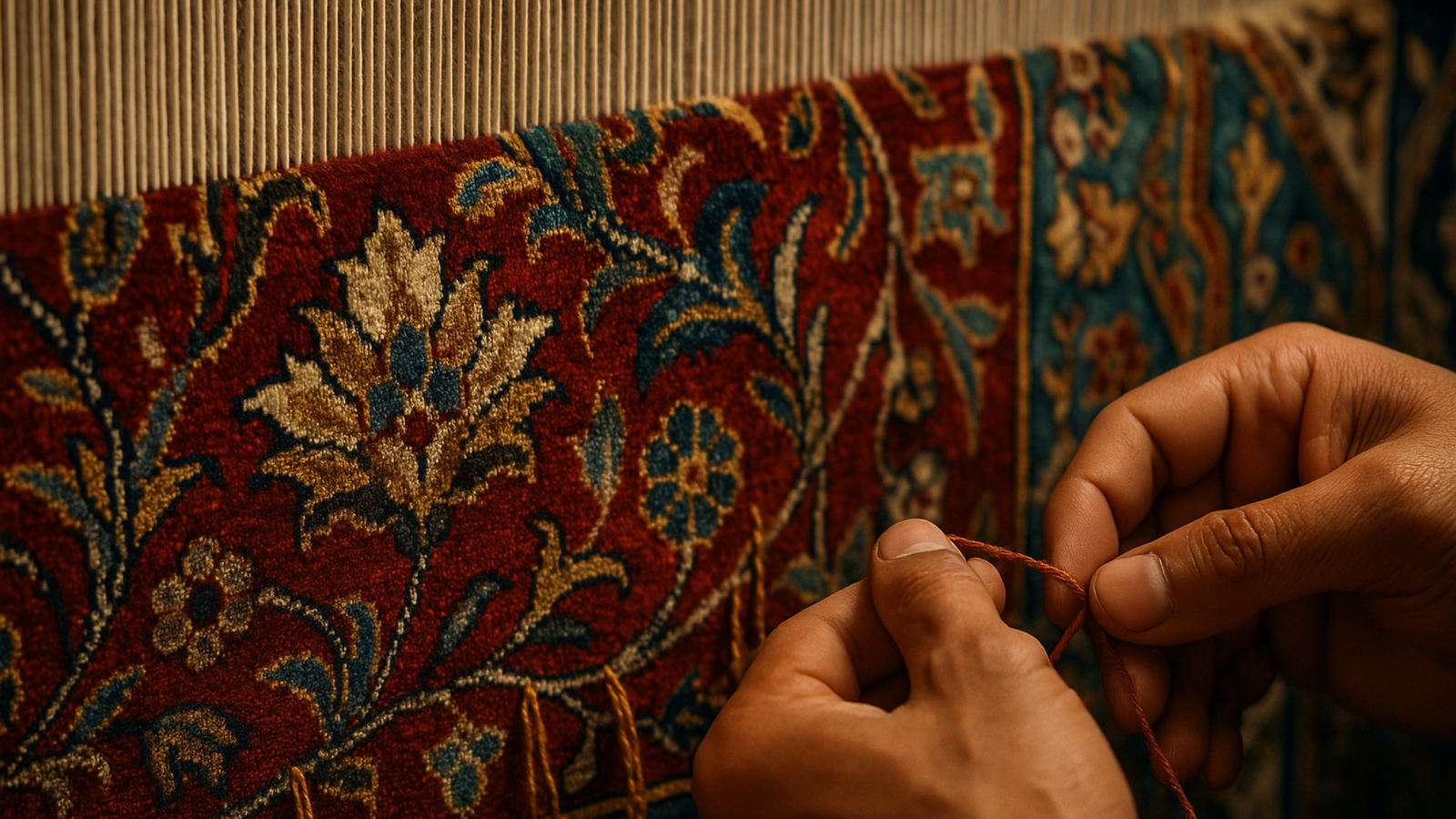
Silk thread is thin; tying a Persian knot around each warp takes skill and time. When density reaches 600 KPSI, labour share climbs to nearly 70 % of the price. Cutting density to 200 KPSI halves man-days and brings the bill down by almost 45 %, yet still delivers a fine rug for light-traffic rooms.
How to Control Budget Without Sacrificing Quality
- Select 300–350 KPSI – Knots stay crisp, time reduces.
- Keep size modest – 5 × 7 ft cuts both yarn and labour by 40 %.
- Limit colour palette – Fewer dye lots mean lower washing fees.
- Pick repeating motifs – Graphing cost drops with easy repeats.
- Order through cooperative workshops – Direct payment to weavers trims showroom margin.
CarpetsAndRug.com offers step-down options plus clear lead-time charts so clients can match budget to room needs.
Payment Schedule in Delhi Workshops
| Stage | % of Price | Purpose |
|---|---|---|
| Contract signing | 30 % | Yarn purchase, design plotting |
| Halfway on loom | 30 % | Weavers’ wage support |
| After finishing | 30 % | Washing, shearing, QA |
| Before dispatch | 10 % | Freight and packing |
Always request loom photos with date stamps before sending the mid-way instalment.
Typical Lead Time
| Size / Density | Weeks on Loom | Finishing | Total Weeks |
|---|---|---|---|
| 4 × 6 ft / 300 KPSI | 10 | 2 | 12 |
| 6 × 9 ft / 400 KPSI | 27 | 3 | 30 |
| 8 × 10 ft / 600 KPSI | 50 | 4 | 54 |
Higher density equals fewer weavers per square inch, so calendars grow.
Quality Checks Every Buyer Should Request
- Line-up photo – Straight edges show balanced tension.
- Back view – Clear knots with no glue residue.
- Pile angle test – Silk grain should shift evenly under light.
- Dry rub – White cloth must stay clean after 15 strokes.
- Shear height gauge – Uniform 6–8 mm pile for even shine.
CarpetsAndRug.com sends a QC pack with ruler photos and video walk-around before requesting the third payment.
Why Delhi Remains a Hub for Hand-Knotted Silk Rugs
- Proximity to Yamuna dye houses – quick colour lab access
- Large artisan clusters in Bhadohi and Mirzapur within overnight truck range
- IGI Airport cargo link for fast exports
- Design studios trained in modern CAD software but fluent in classic nawabi patterns
These factors keep Delhi competitive against Kashmir and Jaipur for mid- to high-density silk pieces.
Final Thoughts
A custom silk carpet is the result of patient craft, not quick factory runs. When you understand each cost layer—material, effort, finishing, and tax—the hand-knotted silk rug price makes sense. Use the breakdown above as a checklist during vendor talks, ask for transparent quotes, and align knot density, size, and colour count with your budget.
CarpetsAndRug.com is ready with free swatches, live loom updates, and honest guidance so your Delhi commission feels smooth from first sketch to final unroll on your floor.
FAQs
1. How does knot density affect the hand-knotted silk rug price?
Higher knot counts mean more knots per inch, so weavers spend extra days on the loom. As labour is over half the cost, the hand-knotted silk rug price rises steeply with density.
2. What is the cheapest size for a pure silk carpet in Delhi?
A 4 × 6 ft rug at 300 KPSI starts around ₹7 lakh, reflecting lower yarn weight and fewer man-days, keeping the hand-knotted silk rug price within reach of small-room projects.
3. Can I reduce GST on a custom order?
No, GST on hand-made rugs is 12 % across India. It is applied to the ex-factory value and must be paid before shipment. Always include it when you tally the hand-knotted silk rug price.
4. How long will colours last in a silk rug?
Proper chrome dyes resist fading for 20+ years indoors. Ask the workshop for dye certificates; good colour fastness protects your investment and the hand-knotted silk rug price you paid.
5. Does CarpetsAndRug.com offer payment plans for high hand-knotted silk rug price orders?
Yes. We follow the four-stage schedule above and can adjust instalments or add escrow options, making a high hand-knotted silk rug price easier to manage.